
Course presentation
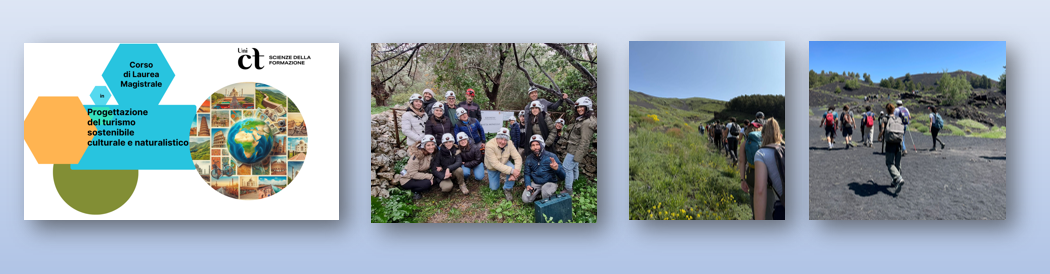
Welcome aboard!!
The Master's Degree Program (MSc) in "Planning of Cultural and Nature-based Sustainable Tourism" (LM-49) at the Department of Educational Sciences provides students the opportunity to enhance their skills through more specialized training consistent with current European programs based on sustainability principles. It aims to achieve the qualifying educational objectives of the LM-49 program, as set out in the tables attached to Ministerial Decree no. 1648 of 19/12/2023 ("Determination of University Degree Classes"), integrated and structured according to specific requirements dictated by an updated analysis of job-market demands.
The project proposal is the outcome of collaborative work between the proposing Department and the Department of Biological, Geological, and Environmental Sciences, and is developed taking into account the needs of the professional world and the recommendations emerging from meetings with stakeholders. It aims to fill a skills gap currently affecting the tourism sector, adapting the training offering to the emergence of so-called "new tourisms," representing a demand attentive to the specificities of local areas, respect for the environment, and local socio-cultural phenomena, for which traditional training for professionals is no longer sufficient.
The Master Course program aims to train tourism professionals capable of combining management and marketing skills with a high cultural profile derived from understanding local disciplines in their dual socio-cultural and geo-nature-based aspects, capable of defining the specificities of contexts for the purpose of sustainable and inclusive tourism development. Particular attention is paid to the skills in developing innovative tourism products (Eco museums, mining parks, greenways, food trails) and in the use of modern methodologies and techniques (ICT) aimed at communicating, managing, and organizing widespread cultural and naturalistic activities.
Graduates of the Master's Degree will have the opportunity to find employment, in coordination and management roles, in hospitality and tourism companies, as destination managers, and in incoming tourism. They may be employed in the design of niche travel experience and marketing, organizing and managing cultural and natural events, and developing promotion and communication protocols. They may work in central and decentralized government institutions in the fields of tourism, culture, cultural and environmental heritage, and local sustainable development. They may also work as consultants for local authorities and administrations and hospitality companies for the cultural promotion of the region and its artistic, environmental, literary, food and wine, and naturalistic heritage. In addition to the professions listed above, there are also those that require direct contact with the region and specific, specialized knowledge, such as mountain guides, volcano guides, nature guides, hiking guides, and nature park guides.
The Master's Degree has open access. It is structured through two years and four semesters. The program provides 120 credits (ECTS), of which 16 are reserved for the final exam, 15 credits for Disciplines of the student's choice, 12 credits for internships and placements at companies, organizations, and institutions in the sector, and 3 credits for additional training activities (UAF), including language and IT certifications and activities aimed at furthering the student's understanding of the world of work.
Forty-eight credits are reserved for the core subjects covered by the program, which, in addition to languages, focus on historical-cultural, economic-managerial, environmental, and social aspects. In addition, 12 to 24 credits are dedicated to related activities, conceived as an integral part of the program, which values multidisciplinary as an added value, consistent with the variety of career opportunities offered by the tourism industry. These courses focus on specializing in knowledge of the physical territory, in line with the new alignment between tourism and local resources. This alignment is the result of an awareness of the "active" value these resources have acquired as drivers of social, identity, and, last but not least, economic development.
Most of the courses offered require a minimum of 3 credits dedicated to laboratory and field-based activities aimed at integrating theoretical knowledge with practical development and communication activities.
Degree students have access to a well-established international internship program (Erasmus+ Traineeship) and have the opportunity to choose the language in which to write their final dissertation and to select a foreign research institution/ centre for their project.
The development potential of the program's fields is encouraged by the presence of a PhD program within the host department.